How to increase investments in green electrification in Finland? – We must use our competitive advantages
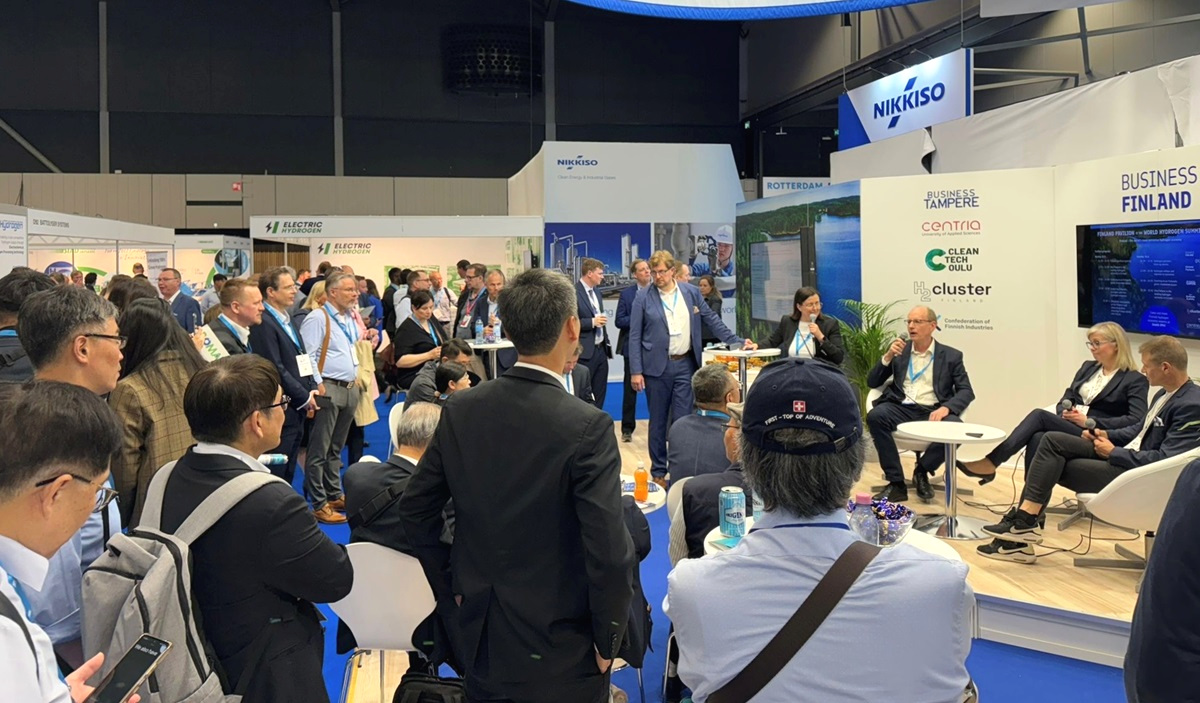
The development of green electrification requires up-to-date research data on the expertise in the field. It also requires taking account of the perspectives of business actors in political decision-making in order to enable investments.
It is possible for Finland to become Europe’s leading producer in renewable energy and synthetic raw materials.
“The Finnish industry must be decoupled from fossil fuels and raw materials on a fast schedule,” says Eeva Lähdesmäki, Project Manager from LUT University.
The free emissions allowances under the EU Emissions Trading System (EU ETS) will be phased out in industry in 2034, in shipping in 2027 and in aviation in 2026. The need for sustainable fuels will multiply from the 2030s forward, but unclear regulation prevents investments.
The chemical industry accounts for nine per cent of Finland’s CO2 emissions. Last year, at 24%, the sector accounted for the largest share of Finnish exports.
“We interviewed chemical industry representatives on the topic. The sector is not motivated to implement the green transition due to lack of market uncertainties and incentives.”
According to Lähdesmäki, Finland should act on time and make use of the production potential of Power-to-X products. In PtX technologies, hydrogen or synthetic fuels are manufactured using electricity based on the use of renewable energy sources.
One of Finland’s competitive advantages is the availability of bio-based, or biogenic CO2, but currently it is not yet utilised.
For the last couple of years, the project group led by Lähdesmäki has been studying the prerequisites for green electrification in an InnoCities leadership project.
“The electrification of the manufacturing industry would mean doubling the electricity consumption in Finland in 10 years,” said Jukka Ruusunen, Industry Professor at LUT University, at the final seminar of the project.
The need for electrification concerns not only the chemical industry but also the steel industry in particular.
Eight research topics where Finland will become a pioneer in the hydrogen economy
In 2024, a LUT University project group carried out a research survey on the state of Finland’s Power-to-X research and reported on eight research topics that can be used to boost Finland’s competitiveness.
“We prioritised the key topics into a roadmap that includes the research topics required to ensure the functioning of the entire value chain. The project involved 12 universities and research institutes,” says Eeva Lähdesmäki.
According to Lähdemäki, one part of the value chain is our competitive advantage, i.e. good availability of electricity and the aforementioned bio-based CO2.
“Most of the biogenic CO2 in Europe is produced in pulp mills in Finland and Sweden.
Finland has a significant amount of research in the field, and there is a lot of international cooperation. To gain a comprehensive understanding of the matter, a comparison was also made based on the perspectives and needs of industry and research.”
Predictability and availability of electricity are important for investors
In autumn 2025, the Green Electrification project group published a report on the outlook of the Power-to-X economy in Finland. In the report, investors share their thoughts on competitive advantages, risks and risk management.
As our competitive advantages, investors consider the affordable price of renewable electricity, the preparation of hydrogen infrastructure, the availability of biogenic CO2, political stability and reliable governance.
As risks, investors consider the direction of national decisions, uncertain EU regulation, lack of demand for PtX products and high production costs. In risk management, the emphasis is on the importance of political predictability, clear support models and the development of energy infrastructure.
“For example, we should develop nodes for electricity, hydrogen and port infrastructure. Well-functioning infrastructure attracts investors. Gasgrid’s plan for a hydrogen trunk network attracts interest, as do the planning areas for wind power. Permit procedures for wind power are slow, so by enabling them we signal about the availability of electricity,” says Lähdesmäki.
Green electrification has taken many steps forward – the national ecosystem plays a key role
The Green Electrification leadership project has examined the development of the investment environment to promote green electrification in various ways. A quick exercise sought concrete proposals for solutions from the perspective of South-Eastern Finland. One of the measures listed was the goal to attract international students to the area.
“Based on this, we brainstormed an internationalisation voucher to support companies in hiring higher education students with a foreign background,” says Lähdesmäki.
The aim is that during 2025 companies from Lappeenranta would employ 30 students with a foreign background with an increased subsidy of EUR 3,000.
Alongside carrying out studies and surveys, the broader objective has been to build a national ecosystem.
“This activity will not end with an individual project, as we have created a functional ecosystem between research, administration and industry. LUT University’s responsibility for the Hydrogen Research Forum Finland has played an essential role in this, as have the research surveys and strategy work we have carried out.”
The other key actors in the ecosystem in addition to the Hydrogen Research Forum Finland are Business Finland and the Hydrogen Cluster Finland.
In addition to LUT University, the Green Electrification leadership project has been implemented by the University of Oulu, which led the Hydrogen Research Forum Finland before LUT.
“Cooperation with the University of Oulu will continue in the new project,” says Lähdesmäki.
More information:
Report: Eight research topics where Finland will become a pioneer in the hydrogen economy – InnoCities (in Finnish)
What is the connection between the chemical industry and green electrification? – InnoCities
This article is the third and final part of series of articles on the Green Electrification leadership project.
Previous article: Making the energy transition happen: Research data sheds light on the outlook for clean energy – InnoCities
Green electrification is one of the themes led by InnoCities. Thematic cooperation pools together city resources and promotes good practices, international cooperation, and investment. Its goal is to accelerate the renewal of business and the deployment of sustainable solutions in cities. InnoCities support innovation, apply research, and carry out experiments.