InnoCities surveyed their strengths in water expertise
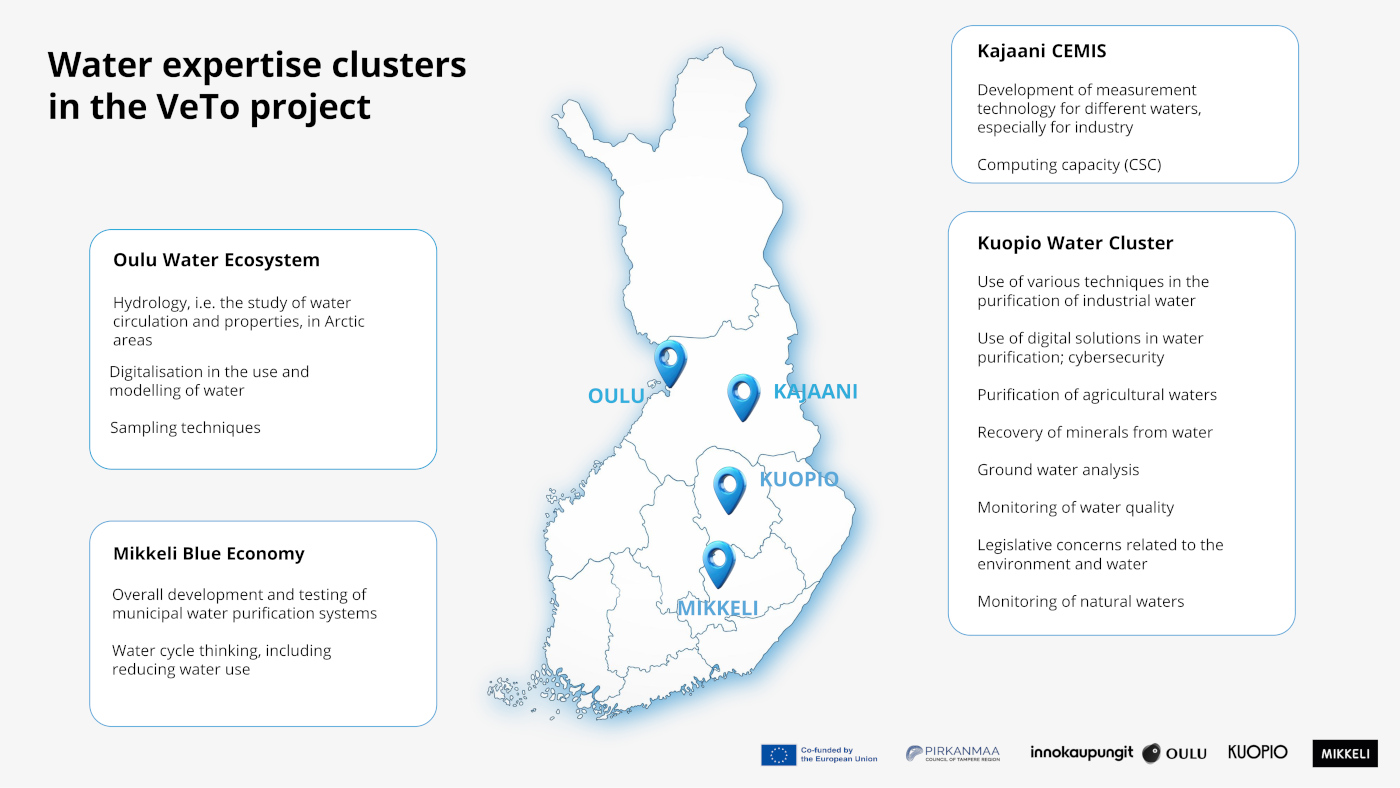
Around Finland, water expertise ranges from municipal waters to studying natural waters and from agricultural water solutions to measurement technologies. Expertise profiling sheds light into the strengths of the different areas and supports their broader utilisation.
The Lead Theme for Water Expertise of InnoCities carried out a project where it profiled expertise in different regions, collecting information on the expertise on the water sector in different parts of Finland. The survey helps highlight the strengths of different cities and what they can offer to companies while forming a foundation for strategic development.
‘Water expertise in Finland has a steady foundation in strong, local clusters. Special areas of expertise have developed in different cities that add value to the whole industry, although these specialisations do also overlap. The goal of the profiling is to bring definition to Finland’s regional areas of specialisation and cooperation localities,’ explains Project Manager Jukka Hakola from Savonia University of Applied Sciences.
Putting ideas to practice in Mikkeli
Mikkeli’s water expertise is especially focused around EcoSairila where municipal water purification solutions are being developed and tested. The area offers companies exceptionally great opportunities to pilot new technologies in a real-life environment. In addition, LUT University and South-Eastern Finland University of Applied Sciences Xamk add to the expertise of Mikkeli; a good example of this is their holistic approach to the water cycle, from reducing water use to its purification and recycling.
Water circulation under extreme conditions studied in Oulu
In Oulu, the area’s water expertise emphasises natural waters and water circulation, focusing on the hydrology of the Arctic regions in particular. Local research produces information on the movements and properties of water under conditions where quick changes and extensive impacts are possible.
Digitalisation is heavily involved in the studies since Oulu’s key areas of expertise include modelling water purification, utilisation of data, and advanced sampling techniques.
Needs of agriculture and cybersecurity highlighted in Kuopio
Kuopio’s water expertise is closely linked with the needs of industry and agriculture. One of the central players in the field is the Savonia University of Applied Sciences, and different water purification technologies are utilised extensively in development work. However, when systems become digital, their security also becomes an important part of water expertise. Cybersecurity is a theme of special interest in North Savo.
The Kuopio water cluster also includes the University of Eastern Finland, the Finnish Institute for Health and Welfare (THL), and the Geological Survey of Finland (GTK), which also add their own expertise to the water cluster’s competence.
Kajaani transforms water into data
Kajaani’s specialty is its strong expertise in measurement technology, which has a lot to offer to the water sector. In particular, these technologies are being developed for industrial needs, but their applications extend to various water purification solutions as well.
The city’s key strengths include the development of measurement methods, the utilisation of data, and its significant computing capacity. Kajaani has a largely cross-sectional role: the measurement technology developed in the area contributes to the work of other operators in the water sector and enables more precise and efficient water management.
Towards a joint water map for the whole Finland
The profiling is not limited to the InnoCities: the goal is to create a comprehensive picture of water expertise in the entire country. The project hopes to bring together all key stakeholders: research organisations, companies, as well as authorities.
‘As an example, key actors from the perspective of health and safety like the Finnish Institute for Health and Welfare have an important part to play in the project, in particular in cases of disruptions and risks. During the water crisis in Nokia, THL was the first on the scene,’ says Hakola.
The map compiling the expertise profiles will be published on the website of the Finnish Water Forum. The map will clearly show the different expertise clusters and help identify cooperation opportunities both domestically and internationally.
The profiling work supports the transition from individual projects towards a more extensive cluster of operators. With a clearer big picture, targeting development measures also becomes more effective.
‘Cooperation and specialisations reduce overlaps in work and enhance our impact in Finland and globally,’ says Hakola.