As many have stated, Europe needs to step up in innovation, productivity and strategic investment. As member states and regions prepare for the next EU program period 2028-2034, the subject of translating ambition into concrete structures has never been more current. The hard part is building the partnerships and commitments that make long-term innovation system development possible.
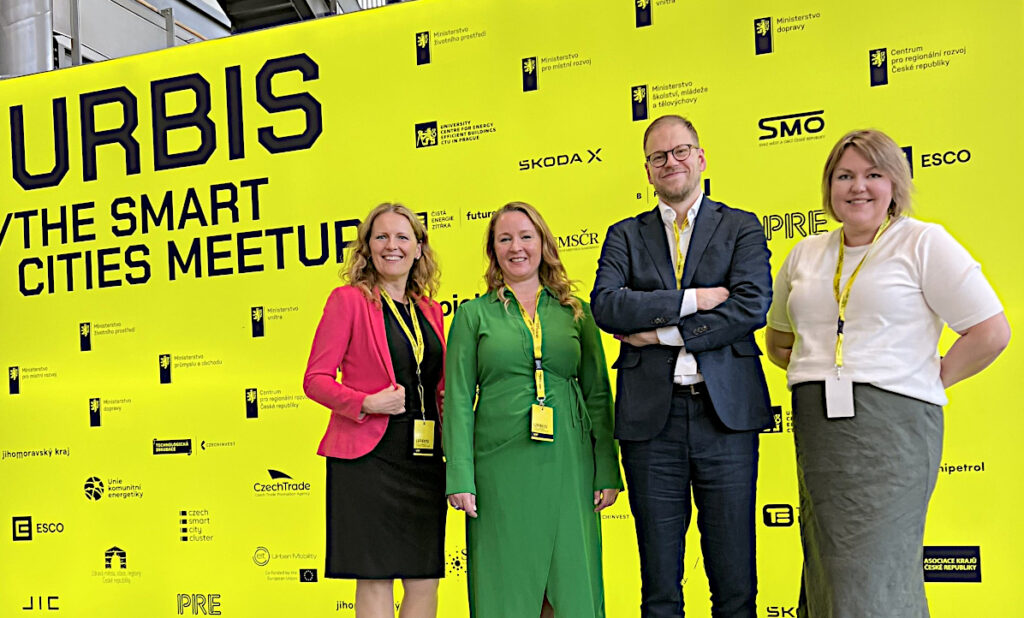
This summer, InnoCities national coordination took part in URBIS The Smart Cities Meetup 2026 in Brno, Czech Republic. The team presented the Finnish multilevel governance model advancing innovation in cities, and joined the broader conversation about what it takes to build regional competitiveness.
URBIS 2026 focused both on the visions of large cities and on the specific challenges faced by smaller municipalities. The goal was to show that there were innovative solutions for municipalities of all sizes that sought more efficient and sustainable development paths. This is where Finland has something to offer.
Closing the governance gaps — From partnerships to competitiveness
Innovation policy is often built on strategies on different levels of governance that outline ambitious goals. At the same time universities produce world-class research and companies innovate to create new solutions. And yet, in cities across Europe, the results fall often short of the potential.
The reason is rarely a lack of ideas but a lack of governance that supports long term innovation system development. Between national strategy and concrete ground-level action often lies a gap: who is responsible for steering an innovation ecosystem? How do we bring together the right actors, direct funding, and hold the long-term vision through political changes. The conversations in Brno confirmed what we see across European regions: the governance question remains largely unanswered.
Finland’s response has been a formal one. Since 2021, the Finnish state and cities have implemented ecosystem agreements with 16 city regions. Agreements have formed binding frameworks that define shared priorities, steer EU funding, and define a clear accountability between national and local levels. The agreements create an institutional structure and backbone for cities to lead and implement.
The model was discussed with an audience working with RIS3 frameworks. Smart specialisation strategies require strong implementation plans and a promise of longevity through political transitions. Ecosystem agreements as a model are one potential answer to that need.
One framework, 16 individual agreements
Europe is full of cities that wish to be known for something: their ecosystems and clusters, innovation environments, specialization and solutions created together with companies. Europe also has several national strategies and models that support cities developing their competitiveness and innovation policies.
The challenge of national models is that they need to work across very different areas and cities. Cities and regions vary in size, economic history, research focus, infrastructure, and the depth of their business ecosystems as well as in culture and the maturity of cooperation structures.
This is the challenge Finland set out to solve with its Ecosystem Agreement model. From Helsinki to Rovaniemi, from Turku to Kajaani, each Ecosystem Agreement shares the same governance logic: a formal commitment between the state and a city, EU funding aligned to local priorities, and a shared leadership structure involving universities and public actors.
But that is where the similarity ends. Tampere focuses on semiconductors, health technology and sustainable urban development. Oulu leads in 6G and digital infrastructure. Mikkeli has built its identity around water expertise and Vaasa around energy. The national framework sets the stage and the cities bring their own performance, shaped by their own strengths, ecosystems and choices.
When InnoCities national coordination presented this model at URBIS 2026 in Brno, what struck Czech colleagues most was the clarity of Finnish cities’ profiles. Each city knew what it stood for and what it didn’t. The question that followed was genuine: how do you actually achieve that level of specialization? How do you prevent cities from drifting toward the same safe strategies, chasing the same trends?
The answer is that the model doesn’t allow it. Each ecosystem agreement is negotiated individually, built on an honest assessment of what a city region genuinely has in research capacity, industry base, and long-term competitive potential.
Another reason is that the cities talk to each other. Through the InnoCities network, cities have built lead themes and joint projects together and by doing so, they have been forced to articulate what makes them distinct. Awareness of others’ strengths sharpens awareness of your own. A city that once spoke broadly about defense now knows exactly where it leads: cyber, maritime security, dual-use technologies, or comprehensive security. These are not the same thing — and Finnish cities no longer treat them as if they were.
Learning together to tackle joint challenges
These two principles — closing the governance gap and promoting strong specialisation — are at the heart of the model Finland has built over the past six years. The conversations in Brno reminded us that the questions Finnish cities have been tackling are not only Finnish. Cities and regions across Europe are working through the same challenges, and there is genuine value in comparing experiences across borders.
Curious about how Finland’s Ecosystem Agreements or InnoCities network? We are happy to exchange ideas with cities, regions and policymakers exploring similar questions.
Additional information
Monna Salmi
+358 44 422 2007
monna.salmi@pirkanmaa.fi
Joonas Lindeman
+358 44 4222 004
joonas.lindeman@pirkanmaa.fi